AvaTax for Communications
Communications REST v2 Dev Guide
Getting Started
Calculate Taxes
Commit/Uncommit
Customizing Transactions

Account Customizations
Transaction Use Cases
- Simple Request
- Multi-line Request
- Jurisdiction Determination
- Interstate/Intrastate Determination
- Tax Override
- Safe Harbor Override
- Private Line
- Proration
- Transaction Information
- Exclusions
- Transaction-Level Commit/Uncommit
- Invoice Date
- Invoice Mode
- Optional Fields
- Adjustments
- Tax Inclusive
- Displaying Tax Results
- Quantity
- Request Config
Exemptions
Sales and Use
Jurisdiction Determination Use Cases
Reference
Calculating Tax Offline
AvaTax for Communications Use Cases
FAQ
Chapter 4.1 - Client Profiles

What is a client profile?
A client profile allows you to customize how the AFC tax engine interprets a request and returns tax results. Customizations include:
- Bundle
- Exclusion
- Tax Override
- AFC Tax Engine configuration
Why use a client profile?
Reasons to use a client profile include:
- Profiles are cached - this speeds up response times
- Using a client profile eliminates including the same customization, such as a tax override, in each CalcTaxes request
- Request a client profile containing customization file(s) and configurations be added to your client
- Specify the
client_profile_idin the header to apply the client profile to all requests run using that header - Multiple profiles can be applied to your client ID. Examples uses for multiple profiles include:
- Separate configurations for different different types of transactions
- Separate configurations for child companies
- Testing new configurations
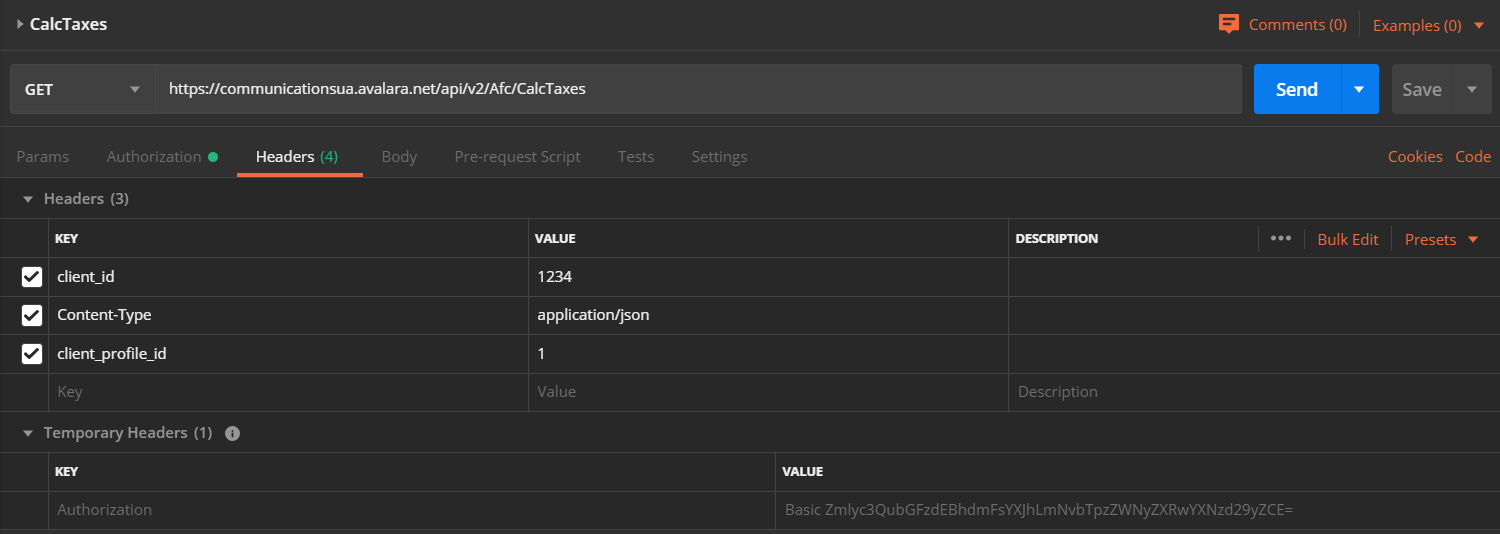
Authorizationusing basic HTTP authenticNoteationclient_idContent-Type: application/jsonclient_profile_id- Do not include
client_profile_id - Set
client_profile_idto "0"
How to apply a client profile to a session
When authenticating to Communications REST v2, pass the client profile ID in the header usingclient_profile_id.Postman example
Add these headers to your request: