AvalaraAvalaraDeveloperDeveloper
  • Productsdown arrow
      Calculations
      AvaTax
      AvaTax Brazil
      AvaTax for Communications
      AvaTax for Excise
      Avalara Tax Content
      E-invoicing
      Activation Service
      Avalara E-Invoicing and Live Reporting
      Brazil
      Brazil Customer Portal
      Tax Compliance (Brazil)
      Tax Central
      Data Staging
      Returns
      Avalara Managed Returns API
      MyLodgeTax
      Avalara Returns Excise
      VAT Reporting
      Shared service
      Shared Services
      1099 & W-9
      Avalara 1099 & W-9
      Tax registrations and business licenses
      Avalara License Guidance
      Sales Tax Registrations
      Payroll tax registrations
      Avalara license filings
      ECM
      Exemption Certificate Management
      Avalara Cross-Border
      Automated Tariff Code Classification
      Self-Serve Tariff Code Classification
      Managed and Premium Tariff Code Classification
      AvaTax Cross-Border (Estimator + Calculator)
      Avalara Trade Compliance
      Avalara Trade and Tariff Library
  • Learndown arrow
      Integrations guides
      Refactor guides
      Get certified
  • Get starteddown arrow
      AvaTax 90 days free trial
      Playground
      Become a partner
      Build with Avalara using AI
  • Developdown arrow
      APIs
      SDKs
      MCPs
      Agent to Agent (A2A)
      AI use cases
      API versioning
  • Resourcesdown arrow
      Avalara NEXT recordings
      Avalara University
      Knowledge Center
  • Support
MENU
Search Icon

No results found for

Profile
  • Sign In
Sign In
Search Icon

No results found for

  • Productsdown arrow
      Calculations
      AvaTax
      AvaTax Brazil
      AvaTax for Communications
      AvaTax for Excise
      Avalara Tax Content
      E-invoicing
      Activation Service
      Avalara E-Invoicing and Live Reporting
      Brazil
      Brazil Customer Portal
      Tax Compliance (Brazil)
      Tax Central
      Data Staging
      Returns
      Avalara Managed Returns API
      MyLodgeTax
      Avalara Returns Excise
      VAT Reporting
      Shared service
      Shared Services
      1099 & W-9
      Avalara 1099 & W-9
      Tax registrations and business licenses
      Avalara License Guidance
      Sales Tax Registrations
      Payroll tax registrations
      Avalara license filings
      ECM
      Exemption Certificate Management
      Avalara Cross-Border
      Automated Tariff Code Classification
      Self-Serve Tariff Code Classification
      Managed and Premium Tariff Code Classification
      AvaTax Cross-Border (Estimator + Calculator)
      Avalara Trade Compliance
      Avalara Trade and Tariff Library
  • Learndown arrow
      Integrations guides
      Refactor guides
      Get certified
  • Get starteddown arrow
      AvaTax 90 days free trial
      Playground
      Become a partner
      Build with Avalara using AI
  • Developdown arrow
      APIs
      SDKs
      MCPs
      Agent to Agent (A2A)
      AI use cases
      API versioning
  • Resourcesdown arrow
      Avalara NEXT recordings
      Avalara University
      Knowledge Center
  • Support
Profile
  • Sign In
Sign In
Sales (877) 282-5585
Chapter 4.1 - Client Profiles
  • Previous
  • Next

What is a client profile?

A client profile allows you to customize how the AFC tax engine interprets a request and returns tax results. Customizations include:

  • Bundle
  • Exclusion
  • Tax Override
  • AFC Tax Engine configuration

Why use a client profile?

Reasons to use a client profile include:

  • Profiles are cached - this speeds up response times
  • Using a client profile eliminates including the same customization, such as a tax override, in each CalcTaxes request
    1. Request a client profile containing customization file(s) and configurations be added to your client
    2. Specify the client_profile_id in the header to apply the client profile to all requests run using that header
  • Multiple profiles can be applied to your client ID. Examples uses for multiple profiles include:
    • Separate configurations for different different types of transactions
    • Separate configurations for child companies
    • Testing new configurations
  • How to apply a client profile to a session

    When authenticating to Communications REST v2, pass the client profile ID in the header using client_profile_id.

    Postman example

    Add these headers to your request:
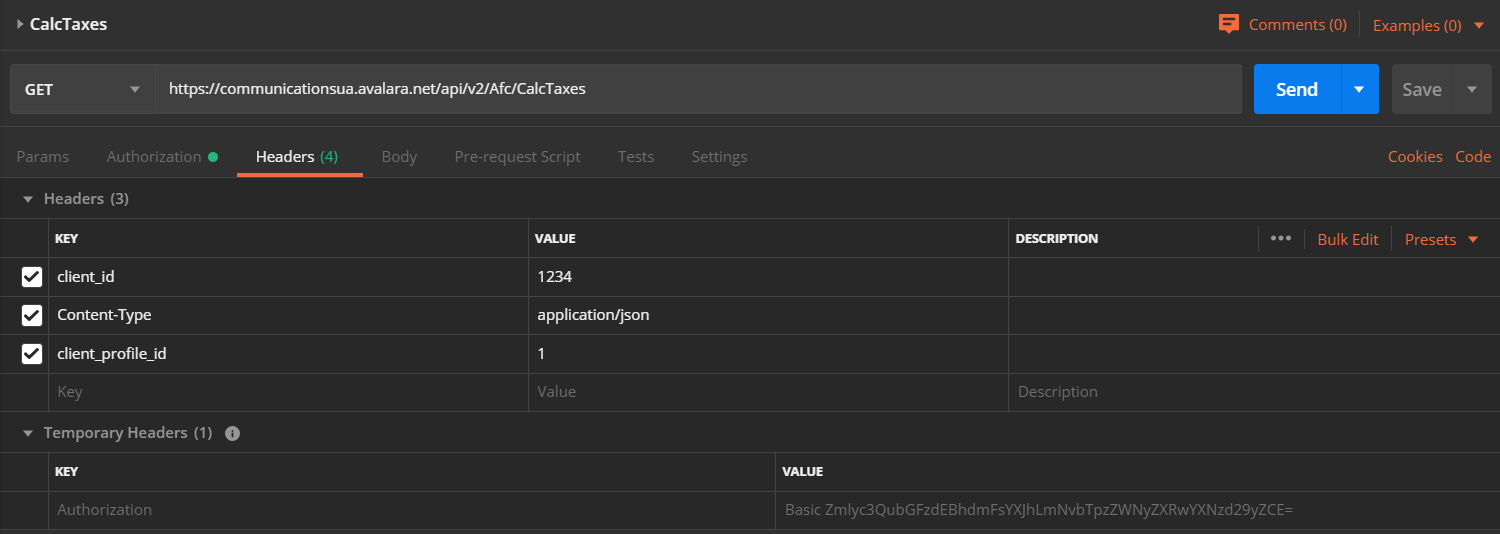
    • Authorization using basic HTTP authenticNoteation
    • client_id
    • Content-Type: application/json
    • client_profile_id

    How to run transactions without a profile

    REST v2 uses the system default profile when a profile is not specified.
    To send a transaction without a client profile, modify the header using one of these options:
    • Do not include client_profile_id
    • Set client_profile_id to "0"

    Note

    The system default profile is "0".
    • Previous
    • Next
PreviousNext
Knowledge CenterDeveloper Support
Avalara.com|Terms of Use|Privacy Policy
© 2026 Avalara, Inc.